

A Development And Evaluation Template For Minor Injuries Telemedicine
This work was performed as an additional part of the SECT(A&E) project.
|
Introduction: Minor injuries telemedicine aims to support minor injuries units and peripheral A&E departments from larger A&E centres through the use of telemedicine. Recent funding from the A&E modernisation programme, along with many local initiatives, have led to a sharp increase in the number of centres experimenting with minor injuries telemedicine. A template has been designed to assist such developments and provide a framework, based on current best evidence, which will guide new users through the development and evaluation of this new technique. Development Phase: The development of a minor injuries telemedicine system can be broken down into eight distinct stages: Stage One: Two Essential Starting Questions Evaluation Phase: As soon as the system starts to be used the evaluation process should also begin. A written contemporaneous record needs to be made of the consultation at both the remote and central site. The essential information required in this evaluation process is as follows: 1. Date and time of call. Optional information includes whether the patient was present during the consultation, whether an X-ray was transmitted and satisfaction scores for patients and staff. The Reckoning: For any new healthcare development audit and formal review are mandatory. Techniques for clinical and economic evaluation are described, along with the experiences of several A&E departments in which minor injuries telemedicine has recently been adopted, and this template employed. For more information see: Benger JR. A development and evaluation template for minor injuries telemedicine. Journal of Telemedicine and Telecare 2001;7(1):58-60. Can Nurses Working In Remote Units Accurately Request And Interpret Radiographs? This work was performed at the peripheral (Tewkesbury) hospital as an additional part of the SECT(A&E) project. |
||
|
||
|
Objective: Recent changes in the National Health Service (NHS) have seen nurses take on roles that are traditionally filled by doctors, leading to the development of “Emergency Nurse Practitioners” (ENPs). In addition to this, increasing interest has focused on telemedicine (literally, medicine at a distance) as a way of supporting remote Emergency Departments and Minor Injuries Units from larger centres. The vast majority of these consultations are related to peripheral limb trauma and require a radiograph to be viewed as an integral part of the telemedical consultation. The aim of this study was therefore to determine whether nurses working alone in a peripheral unit are able to appropriately request, and accurately interpret, peripheral limb radiographs. |
|
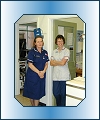
Nursing staff at the peripheral (Tewkesbury) hospital. |
Methods:
In this prospective study the four qualified nurses working in a peripheral unit were permitted to request a defined set of radiographs following limb trauma. A written protocol for nurse-requested X-rays was supported by individual teaching sessions. At the time that the radiograph was requested basic demographic details were recorded and the patient was also assessed by two senior doctors in Emergency Medicine, one in person and one via a telemedicine link, both of whom independently considered whether the radiograph requested by the nurse was appropriate in that patient. Nursing staff were also asked to provide a provisional interpretation of each film, and this was compared to a gold standard derived from the interpretations of the two emergency physicians who had seen the patient and the final radiologist’s report.
Results:
The first 300 patients who had a radiograph requested by a member of the nursing staff were studied over a period of 12 months. 93 radiographs (31%) were positive for recent bony trauma or radio-opaque foreign body. Eleven radiographs (3.7%) were judged by both emergency physicians to be inappropriate. Three X-rays (1%) were requested outside the limits of the protocol, but all three were judged to be appropriate and occurred within the first two months of the study. 32 (10.7%) of the radiographs were incorrectly interpreted by nursing staff with 26 false positives, 4 false negatives and two cases where the nurse observed an abnormality but failed to identify it correctly. The sensitivity of nurse interpretation was therefore 96%, with a specificity of 87%.
Conclusion:
Experienced nurses, working without continuous medical supervision in a remote unit, are able to request appropriate radiographs of the peripheral limbs. Nurses requesting radiographs in this way can also interpret these films to a high standard, though with a tendency to err on the side of caution, generating many more false positive results than false negatives.
For more information see:
Benger JR. Can nurses working in remote units accurately request and interpret radiographs. Emergency Medicine Journal 2002;19:68-70.